Leather Strop and Compound: How Carvers Keep an Edge Sharp
Every guide on this site ends the same way: strop your blades. This page is the full explanation — what a leather strop actually does to an edge, why carvers reach for it instead of a stone for routine upkeep, the stropping technique itself, and how to maintain all five chrome vanadium blades in the CarveKind carving kit. Both pieces of sharpening gear — the grinding leather and the polishing wax — are included in the CarveKind 8-piece kit, so there's no need to buy them separately before your first session.
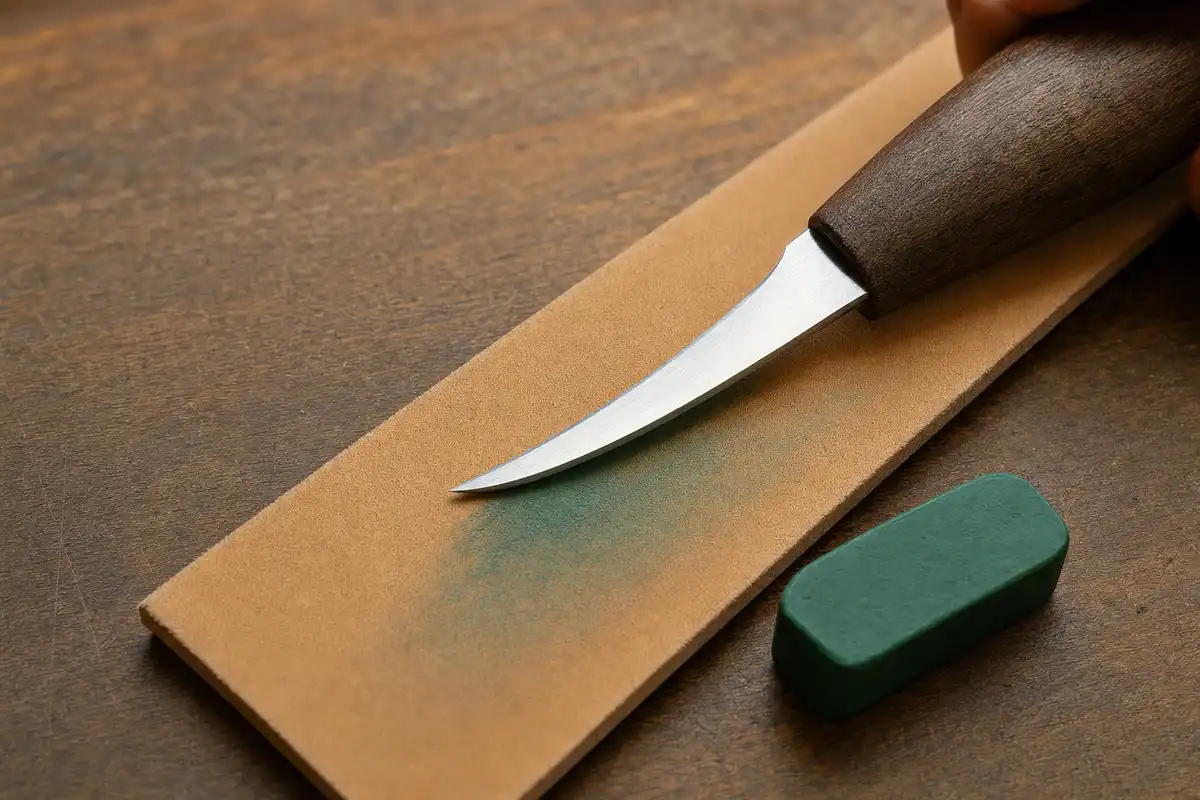
What stropping actually does to an edge
A carving edge rarely "wears out" during normal use — it deforms. The apex of the edge is thin enough that pressure against wood gradually folds and burrs it, and a folded edge crushes fibers instead of shearing them. That's the drag you feel when a knife that cut beautifully an hour ago starts needing force. The fix doesn't require removing steel; it requires straightening and polishing what's already there. Leather is firm enough to support the bevel and yielding enough to contact the whole edge, and the polishing compound adds just enough fine abrasion to smooth the apex as it realigns. The result, a minute later, is a blade that shaves cleanly again — with essentially all of its steel still on the knife.
Strop vs. sharpening stone vs. honing rod
| Method | What it does to the edge | Steel removed | When carvers use it |
|---|---|---|---|
| Leather strop + compound (in the kit) | Realigns and polishes the apex | Minimal | Routinely — whenever the edge starts to drag |
| Sharpening stone | Regrinds the bevel | Significant | Only when an edge is chipped or truly dull |
| Honing rod | Straightens rolled kitchen-knife edges | Little | Rarely for carving — a poor match for flat carving bevels |
The practical consequence: a carver who strops habitually may go a very long time without needing a stone at all, because the edge never degrades past what leather and compound can recover. Skip the stropping, and every knife eventually needs the slower, steel-eating repair job instead. Our sharpening guide covers the judgment call — how to tell a tired edge that wants the strop from a damaged edge that needs a stone.
The strop and compound in the CarveKind kit
Kit strops are often an afterthought; buyer feedback suggests this one isn't. A verified buyer from Denmark examined the set and reported: "The tools look very nice, blades are made of thick steel. Sharpening leather is multilayer." The green polishing wax is the compound half of the system — visible as the green block in the kit photos on our reviews page — and one block lasts a very long time, because each charging uses only a light film. Together they mean the kit is self-maintaining from day one: the same $39.99 box that carves the spoon keeps the spoon knife sharp.
How to strop a carving knife, in four steps
- Charge the leather. Rub the green polishing wax across the strop's surface in a light, even film — a few passes is plenty. Recharge when the leather stops darkening the steel as you strop.
- Lay the bevel flat, edge trailing. Place the blade on the leather with the cutting edge facing away from the direction you're about to move. Edge trailing is the whole trick: stroke into the edge and you'll slice the strop.
- Stroke away from the edge, then alternate sides. Draw the blade spine-first along the strop with moderate, even pressure, lift, flip, and repeat on the other side. A dozen alternating strokes per side is a sensible starting routine.
- Test and stop. A well-stropped blade slices a strip of paper cleanly or takes a whisper-thin shaving off softwood without force. Sharp is the goal — there's no bonus for extra strokes.
Two safety notes worth repeating even here: stropping is always edge-trailing, and carving is always cutting away from your body. Both habits come from the same principle — the sharp side never moves toward anything you care about. More basics in the beginner's carving guide.
Maintaining all five chrome vanadium blades
The four straight-edged blades in the kit — sloyd, chip carving, oblique, and trimming — strop exactly as described above: bevel flat, edge trailing, alternate sides. The hook knife is the exception, because its curved edge can't lie flat; work it in sections along the sweep, rolling smoothly through the curve with each edge-trailing stroke. Chrome vanadium alloy steel takes and holds an edge well — a Canadian buyer's assessment was simply "Very sharp. Steel seems good quality" — and steel that arrives sharp is precisely the kind worth maintaining rather than regrinding. After stropping, wipe the blades and store them in the canvas roll bag so the fresh edges never knock together in a drawer. Blades used on green wood deserve the wipe-down especially: moisture is harder on an edge's longevity than carving ever is.
When you actually feel the difference
Stropping sells itself the first time you carve with a maintained edge next to a neglected one. Cuts need less force, which means more control, which — as we note on every page, from whittling knife basics to spoon hollowing — also means more safety, since a blade that slices where you point it never has to be forced. Test cuts on scrap from our best wood for carving list make the before-and-after obvious, and the easy whittling projects are far more fun on a fresh edge.
Average monthly US searches for 'leather strop'
— DataForSEO keyword data, 2026
Average monthly US searches for 'strop compound' — the abrasive half of the system
— DataForSEO keyword data, 2026
Average rating across 192 verified buyers of the CarveKind 8-piece kit, strop and wax included
— CarveKind verified buyer data, 2026
free shipping to the US · 30-day money-back guarantee
See how we test for the criteria behind every claim on this page.
Leather strop FAQ
Do I need a sharpening stone if I have a leather strop?
Not for routine upkeep. Stropping with compound keeps an already-sharp edge working for a long time, and the CarveKind blades arrive sharp out of the box. A stone only enters the picture when an edge is chipped or genuinely dull — a repair job, not maintenance. Most hobby carvers strop constantly and reach for a stone rarely, if ever.
What is the green compound included in the CarveKind kit?
It is a polishing wax — a fine abrasive compound in a solid block that you rub onto the leather strop to charge it. The green block is visible in the kit photos on our reviews page. Rubbed onto the grinding leather, it turns plain leather into a precise polishing surface for the five blades.
How do you strop a hook knife on a flat strop?
Work the curved edge in sections instead of laying the whole bevel flat: strop one part of the curve at a time along the leather, always with the edge trailing, and roll smoothly through the sweep as you stroke. It takes a few more passes than a straight blade but uses the exact same strop and compound.
How often should carving knives be stropped?
Strop whenever the blade starts to drag or crush fibers instead of slicing cleanly — for many carvers that means a quick minute at the start of each session and again partway through a long one. Little and often beats long and rare: frequent light stropping means the edge never gets far from sharp.
Related pages
The strop and polishing wax ship inside the kit shown on the wood carving knife homepage. See what they're maintaining on the wood carving tools page, the curved-blade special case on the hook knife page, and the full sharpening decision tree in the sharpening guide.